 stLouIST
Aggregator

Bank of O'Fallon Exec Pleads Guilty To Swindling $2 Million In Check Kiting Fraud Scheme
EAST ST. LOUIS/O'FALLON, IL. — Andrew P. Blassie, the former executive vice president of the Bank of O’Fallon, pleaded guilty Monday in federal court to charges of bank fraud and interstate transportation of funds obtained by fraud after admitting to a scheme that swindled nearly $2 million from the bank. The 69-year-old St. Louis resident acknowledged using a check kiting scheme between September 2023 and September 2024 to falsely inflate his personal checking account balance at the Bank of O’Fallon by depositing checks he knew were backed by non-sufficient funds from accounts at other financial institutions. The indictment states Blassie defrauded the bank of $1,972,887.67 and used the inflated funds to pay for nearly $2.7 million in personal expenses. Blassie also persuaded a couple from Lebanon, Illinois, to invest $489,000 of their retirement savings between August 2022 and September 2024 by issuing promissory notes promising interest payments. He used proceeds
MCT Summer Youth Pass Returns For 2025
PONTOON BEACH — With summer just around the corner, Madison County Transit (MCT) is excited to announce the return of the MCT Summer Youth Pass for 2025. This free pass is available to all Madison County students, ages 18 and under, and provides unlimited rides on MCT’s fixed-route buses from Memorial Day through Labor Day. “For more than 15 years, the MCT Summer Youth Pass has helped local students get where they need to go—safely and independently,” said SJ Morrison, MCT Managing Director. “Thanks to the continued support of the MCT Board of Trustees, students across Madison County can enjoy free, reliable transportation to summer jobs, classes, parks, pools, libraries, and more—all while gaining confidence and independence.” Since launching in 2008, the Summer Youth Pass program accounts for over half a million student boardings, providing a valuable transportation resource for families each summer. This year, MCT has distributed
Police identify pedestrian killed in Tower Grove South
Amber Rai, 68, was hit by a Jeep at about 10:30 a.m. May 12 at Gravois and Spring avenues, police said.
Triad High School Student Daniel Winfield Scores Perfect 36 On ACT
TROY - Daniel Winfield of Triad High School achieved a perfect score of 36 on the ACT, the school announced recently. Triad High School officials expressed pride in Winfield’s achievement and anticipation for the opportunities that may follow. "Only a fraction of our students ever achieve a perfect 36 on the ACT, and we couldn't be more proud of Daniel," said Triad High School administration. "We are excited to see what opportunities lie ahead for Daniel." The ACT is an entrance exam used by most colleges and universities to make admissions decisions. It is a multiple-choice, pencil-and-paper test administered by ACT, Inc. The purpose of the ACT test is to measure a high school student's readiness for college, and provide colleges with one common data point that can be used to compare all applicants. The categories broken out of the ACT are English, Math, Reading, Science and Writing (optional).
Eureka High Unveils Newly Renovated Metal Shop
From Leader Publications: Eureka High School’s metal shop was recently transformed from an area used for storage to a place for students to gain hands-on experience with industry-standard welding tools. Students and industrial technology teacher Benjamin Ferrell showed off the new space during an open house on May 7. The renovated shop has 12 booths […]
Man dies in double shooting in city's Mark Twain neighborhood
The 44-year-old victim died at a hospital after being found on the curb in the 5000 block of Queens Avenue last Thursday night.
Free Groceries, Health Screenings and Haircuts Available in Alton/Swansea
ALTON - This month’s Block Party for Good will offer free groceries, hot meals, health screenings and, for the first time, haircuts. Located at Soulcial Square adjacent to the Salvation Army and Crisis Food Center in Alton, the Block Party for Good provides free groceries to community members. From 2–4 p.m. on Friday, May 23, 2025, community members can stop by Soulcial Square to receive groceries, a hot meal through the Currency of Caring food truck network, and more. “At Soulcial Kitchen, powered by Food is Love, we believe that serving others isn’t just about feeding their stomachs — it’s about nourishing their spirit,” said John Michel, founder of Soulcial Kitchen and President of the Food is Love Foundation. “This Block Party for Good model is a powerful example of what happens when compassion, community capacity, and innovation converge.” In addition to the groceries, provided by the St. Louis Area Foodbank, and the ho
Missing Florissant girl has been found

FEMA to assess St. Louis tornado damage this week. Help for homeowners is uncertain
Once the assessment is complete, Missouri Gov. Mike Kehoe will ask President Donald Trump for federal assistance for individual homeowners and renters.
Saint Louis Public Schools bus disruptions continue after storm; some routes are running, but no guarantees
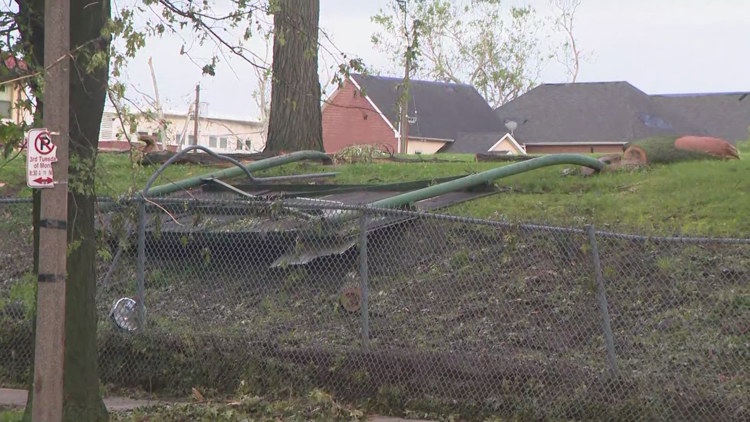
New Spectrum Logo Announced
On This Day, May 20, 2013: The Doors keyboardist Ray Manzarek died at 74
Ray Manzarek, co-founder and keyboardist of The Doors, passed away at the age of 74. Earlier in the year, the rocker had been diagnosed with a rare form of bile…
Before-and-after satellite images reveal tornado devastation in north St. Louis
New shocking satellite images show widespread damage in north St. Louis before and after a deadly tornado ripped through the region last Friday.
Artist of the Month Mary Berry Connects Through Creativity
ALTON - Artist Mary Berry has rediscovered color. Berry, who experiments with sculpture, prints, paint and photography, has her art on display at Milton Schoolhouse through the end of May. She shared that her decision to pursue art was an act of self-care, and she is “exhilarated” to find that her work is resonating with others. “Creativity has helped define another side of myself at this stage of life,” she said. “Before, it was being a wife and mother, then a career in real estate. Retirement gives us an opportunity to explore the side of ourselves we sometimes push aside in order to meet life’s many obligations." The Jerseyville-based artist recently returned to the Riverbend area after years on the East Coast. She worked as a real estate agent and now serves as a caregiver to her mother. In 2022, her friend Darla Cavins introduced her to art and encouraged her to use it as “therapy, because it feels good to get your emotions ou
The Mental Health Benefits of Spending Time in Nature
Imagine a place where your mind can quiet down, your stress levels drop, and your overall mood lifts—all without medication or therapy. For many people, that place is nature. But why does spending time in natural environments hold such profound benefits for mental health? This article explores the powerful connection between nature and the mind, unpacking the science, sharing compelling examples, and offering practical advice for incorporating nature into your daily life. The Science Behind Nature’s Impact on Mental Health Research has increasingly shown that exposure to natural settings positively influences mental well-being. A landmark 2019 study published in Scientific Reports found that spending just 120 minutes per week in green spaces—parks, forests, or other natural environments—correlates with significantly better health and well-being. The benefits include reduced stress, improved mood, and enhanced cognitive functioning. Biologically, nature help
This Day in History: Levi Strauss Receives Patent for Levi Jeans
May 20th holds a significant place in world history, marked by groundbreaking achievements and pivotal moments that have shaped our global narrative. Moving back in time, May 20 has witnessed remarkable events across various domains. For instance, in 325 AD, the First Council of Nicaea concluded on this date. This council was the first effort to attain consensus in the Christian church through an assembly representing all Christendom. It was convened by Emperor Constantine and resulted in the Nicene Creed, a statement of Christian faith still used today. The council addressed the nature of the Son of God and his relationship to God the Father, setting foundational theological principles that have shaped Christianity for centuries. Fast forward to 1498, another milestone was reached when Portuguese explorer Vasco da Gama arrived in the Indian city of Calicut (now Kozhikode) on May 20. This voyage was significant as it established a sea route from Europe to Asia, opening the door
‘living- language- land’ Inspired
The St. Louis Artists' Guild is proud to present an exhibition with SAQA KS-MO-OK Regional members (primary and secondary) whowere asked to select at least one word and create one […]
The post ‘living- language- land’ Inspired appeared first on Explore St. Louis.
Chaotic and Harmonious by Ladan Bahmani and Brian Patrick Franklin
The St. Louis Artists' Guild is proud to host Chaotic and Harmonious, an exhibition of the collaborative work of Ladan Bahmani and Brian Patrick Franklin, contemplates the role of repetition […]
The post Chaotic and Harmonious by Ladan Bahmani and Brian Patrick Franklin appeared first on Explore St. Louis.
Collected: St. Louis History Brought to Life
For more than 150 years, St. Louisans have entrusted the Missouri Historical Society with countless objects: photographs, diaries, home movies, clothing, books – items that future generations can turn in […]
The post Collected: St. Louis History Brought to Life appeared first on Explore St. Louis.